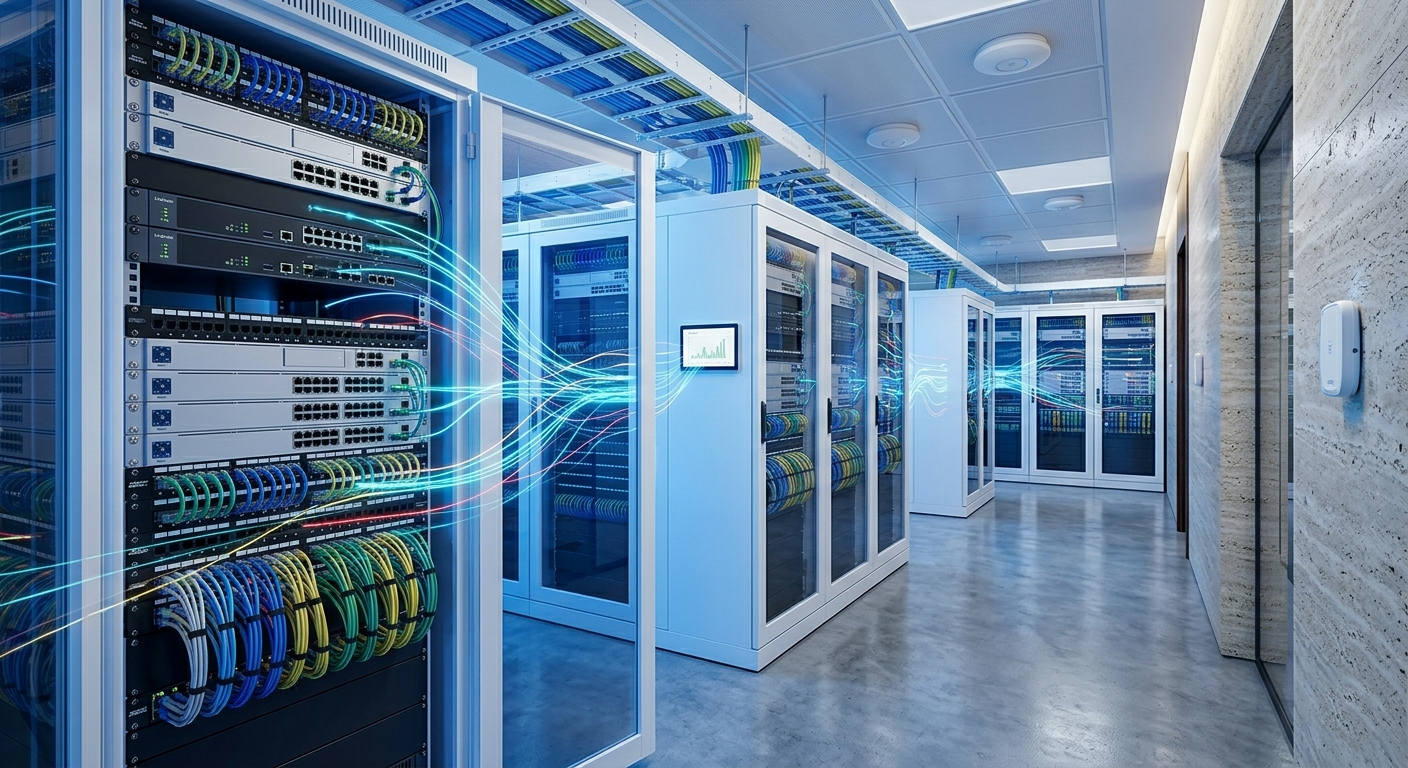
What is meant by network infrastructure?
Network infrastructure refers to everything related to establishing and operating a stable internal internet network, including:
- Network cable extensions
- Distribution devices (Router / Switch)
- Wi-Fi Access Points
- Server rooms
- Cable management systems
Why is the network more important than the devices themselves?
Many clients focus on buying powerful devices but overlook the network. 📌 The Truth: Even the best cameras or systems will not work efficiently without a strong network.
A good network ensures:
- Stable connection speed
- No system interruptions
- High broadcasting quality
- Instant device response
Where do you need professional infrastructure?
- Companies and offices
- Warehouses
- Commercial stores
- Large villas
- New projects
Professional Network Components
🔹 1. Network Cabling
- The primary backbone of the network.
- It is preferable to use high-quality cables (Cat6 or higher).
- Organized extension inside walls or designated conduits.
🔹 2. Switch
- Connects all devices within the network.
- Distributes the connection professionally.
- Suitable for medium and large projects.
🔹 3. Router
- The internet connection point.
- Controls network distribution.
- Manages the external connection.
🔹 4. Wi-Fi Access Points
- Distributes the internet within the site.
- Complete coverage without interruption.
- Reduces signal weakness.
🔹 5. Rack / Server Room
- Organizes devices and cables.
- Protects equipment.
- Facilitates maintenance.
How to improve Wi-Fi coverage?
If you suffer from weak internet:
Solutions:
- Distribute Wi-Fi points correctly.
- Use Access Points instead of traditional extenders.
- Reduce obstacles (thick walls).
- Adjust network settings.
Difference Between Home and Commercial Networks
| Element | Home | Commercial |
|---|---|---|
| Number of Users | Low | High |
| Network Load | Low | High |
| Need for Stability | Medium | Very High |
| Infrastructure | Simple | Professional |
Common Network Mistakes
❌ Using cheap devices: Leads to poor performance and continuous interruptions.
❌ Poor distribution of Wi-Fi points: Creates dead zones without coverage.
❌ Lack of cable organization: Makes maintenance difficult and affects quality.
❌ Lack of advance planning: Especially in new projects.
How to choose the right network for you?
Ask yourself:
- How many users are there?
- What is the site area?
- Are there systems relying on the network (Cameras / PBX)?
- Do you need high speed or long-term stability?
Are networks connected to security systems?
Yes, directly 👇
- Cameras need a strong network for broadcasting.
- Smart systems rely on connectivity.
- PBX needs constant stability.
📌 Therefore, it is best to implement an integrated solution (Network + Systems).
Steps to establish a professional network
- Site survey
- Determine network points
- Extend cables
- Install devices
- Configure settings
- Performance testing
The Future of Networks in Saudi Arabia
With digital transformation:
- Spread of optical fibers (Fiber optics)
- Increased reliance on smart systems
- Growth of digital businesses
- Expansion of smart cities
Conclusion
The network is not just the internet… It is the foundation upon which everything relies. The more your network is:
- Organized
- Strong
- Properly designed
The better performance you will get for all your systems.
Leave a Reply